Electricity bills can be annoying to figure out sometimes. You use the electricity all month and then the bill arrives with a number that may be higher than you expected.
If you want to work out roughly how much you should pay there is a pretty simple way to do it.
You need to know how many kilowatt-hours you used. You will usually find this number on your electricity bill. It may say something like 650 kWh.
Then look at the price per kWh.
For example let’s say the price is $0.16 and your usage was 650 kWh.
Just multiply them.
650 × $0.16 = $104
So the electricity itself would cost about $104.
That doesn’t always mean your final bill will be $104 though. There may be a fixed charge on the account and there can be taxes or other fees too.
That’s why I usually think of this as an estimate rather than the exact bill.
Using the Meter
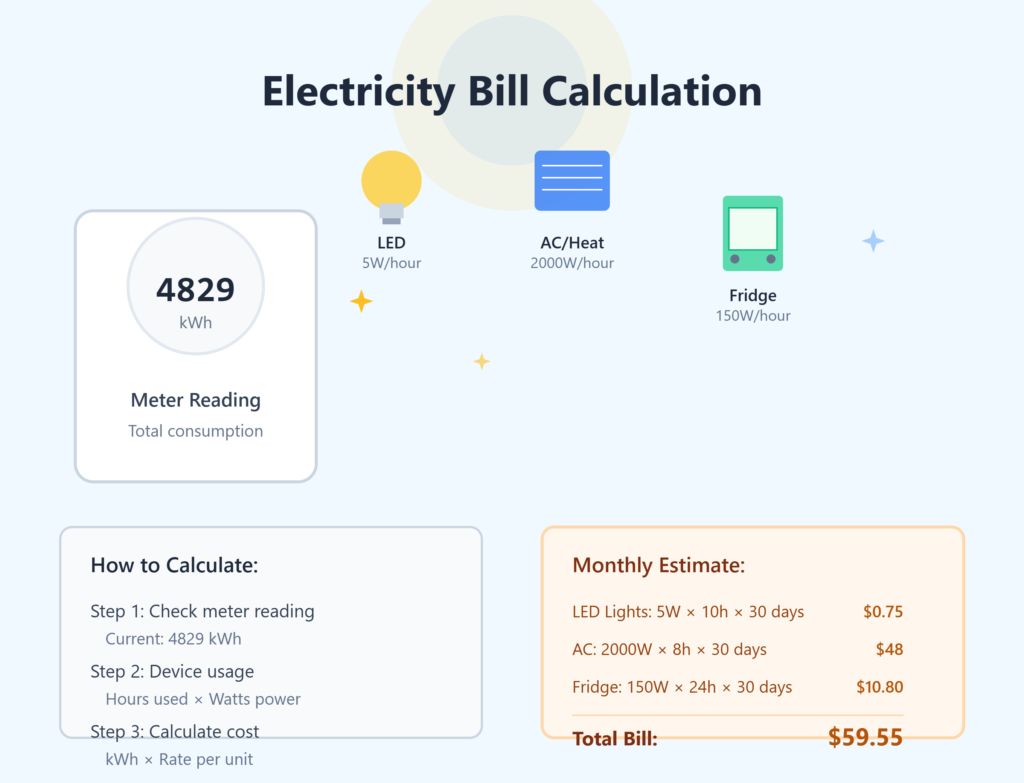
You can also work out your usage from the meter if you have the readings.
Say the previous reading was 18,250 kWh and the current reading is 18,900 kWh.
The difference is 650 kWh.
18,900 – 18,250 = 650 kWh
Now you have the number you need for the calculation.
Some people probably never look at their meter unless there is a problem. I used to be the same way. But checking the number once in a while can actually tell you quite a bit about how much electricity you’re using.
The Price Per kWh Matters
The rate is not the same everywhere.
Let’s say your electricity company charges $0.20 instead of $0.16.
With 650 kWh the calculation becomes:
650 × $0.20 = $130
Same amount of electricity but a different price.
So if you’re trying to estimate your own bill don’t just use a rate you found somewhere online. Check your bill and use the rate that applies to you.
What About the Other Charges?
This is where the final number can change.
Imagine your electricity usage comes to $104.
Then there is a $10 service charge.
Now you have $114.
If there are taxes or other fees those need to be added as well.
So you can use this basic calculation:
Usage × Rate + Other Charges = Estimated Electricity Bill
Some electricity companies also have different rates depending on how much electricity you use. If that’s the case the calculation won’t be quite as simple.
You Can Also Check Your Appliances
Sometimes I find it easier to understand a bill by looking at the appliances in the house.
Take a 1,000 watt heater for example.
1,000 watts is 1 kilowatt.
If it runs for 4 hours you get:
1 × 4 = 4 kWh
At $0.16 per kWh that’s:
4 × $0.16 = $0.64
That’s for four hours of use.
The important thing is that appliances aren’t always running at their full power the whole time. A refrigerator for example turns on and off. So the number printed on the appliance can only give you an estimate.
Still it can be useful if you’re trying to find out what might be using a lot of electricity.
Why Did My Bill Increase?
If your electricity bill suddenly goes up I’d look at the kWh before anything else.
Let’s say you normally use around 600 kWh.
This month you used 900 kWh.
That’s a 300 kWh increase.
Something changed.
Maybe you used the AC more than usual. Maybe there was a heater running for several hours every day. Maybe you simply spent more time at home.
It’s much easier to figure this out when you compare the usage rather than only looking at the amount you have to pay.
A Quick Example
Let’s say your usage for the month is 800 kWh.
Your rate is $0.18 per kWh.
800 × $0.18 = $144
Then you have a $15 fixed charge.
$144 + $15 = $159
If your provider adds taxes or other fees you add those to the $159.
That’s basically how I would estimate it before the actual bill arrives.
If you want to make the calculation faster you can use our Electricity Bill Calculator. You enter the electricity usage and rate and it does the basic math for you.
One Thing Worth Checking Every Month
I wouldn’t only keep track of the money.
Keep an eye on the kWh too.
If your bill was $120 last month and $150 this month that tells you something but it doesn’t tell you why.
If your usage went from 600 kWh to 850 kWh then you know you used quite a bit more electricity.
That’s a much better starting point.
You can then think about what was different during that month. Sometimes it is the weather. Sometimes it is an appliance. Sometimes you just used more electricity without really noticing.
Final Thoughts
You don’t need anything complicated to get a rough idea of your electricity bill.
Find your kWh usage and the price per kWh.
Multiply them.
Then add the fixed charges and any other fees that apply.
The exact bill can still be different because every electricity provider has its own pricing system. But the basic calculation gives you a good idea of what to expect.
And if you’re trying to reduce your electricity bill I’d start by watching the kWh number. It’s probably the most useful number on the whole bill.
Frequently Asked Questions
How do I calculate my electricity bill?
Multiply your electricity usage in kWh by the price you pay per kWh. Then add any fixed charges taxes and other fees.
What does kWh stand for?
kWh means kilowatt-hour. It is the unit used to measure how much electricity you use.
Can I calculate my usage from the meter?
Yes. Subtract the previous meter reading from the current reading to find the amount of electricity used.
Why is my electricity bill higher this month?
Check your kWh usage first. If you used more electricity than usual the higher bill may simply be caused by increased consumption.
How can I estimate the cost of an appliance?
Convert the appliance’s wattage to kilowatts. Multiply that by the number of hours it runs and then multiply by your electricity rate.
If you want to check your electricity cost without doing the math yourself you can use our Electricity Bill Calculator. Just enter your usage and electricity rate and you can get an estimate in a few seconds.