You receive a message from your employer, your wage is going up. Then, you check the figures and wonder what it all means.
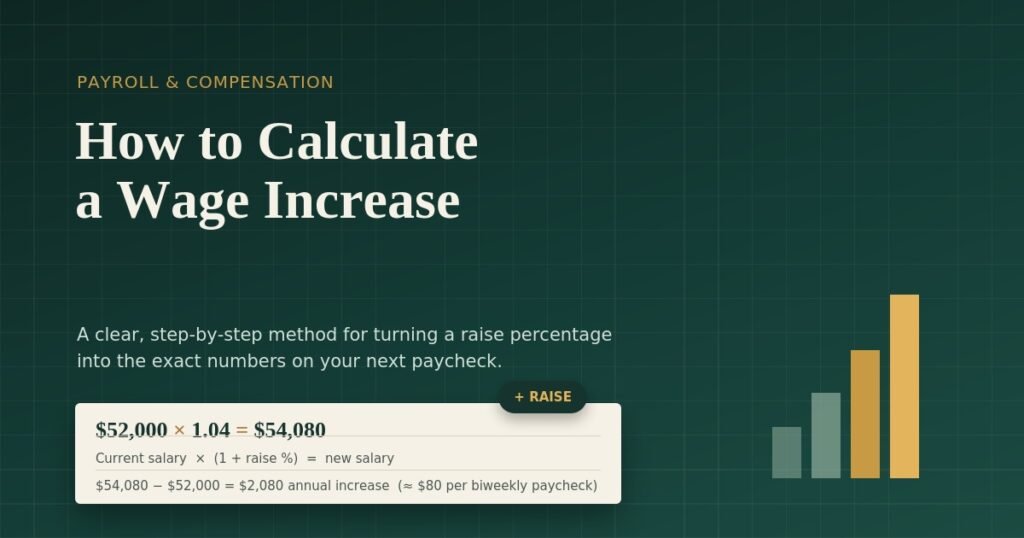
There are only two things you need to calculate a wage increase. Your old wage and your new wage. You can see both the increase in dollars and the percentage of the increase.
If you want to check your own numbers, you can use our wage Calculator to calculate your wage increase quickly.
How to Calculate a Wage Increase
Start with finding the difference between your new and old wage.
New Wage − Old Wage = Increase
If you want the percentage increase it is simply
(New Wage − Old Wage) ÷ Old Wage × 100 = Wage Increase %
Let’s look at a simple example.
Let’s say you used to be earning $20 an hour, and your new wage is $22 an hour.
Your increase is then
$22 − $20 = $2
We divide the increase of $2 increase by your old $20 by the old wage:
$2 ÷ $20 = 0.10
And then multiply this by 100:
10%
So you had a 10% wage increase from your employer. Seems simple enough.
Calculating a Wage Increase in Dollars
Say you aren’t too fussy about percentages, and just want to see how much extra cash you are going to earn.
If your hourly wage increases from $18 to $19.50.
The difference is
$19.50 − $18 = $1.50
So you will be earning an extra $1.50 every hour worked. If you work 40 hours a week, then you take your increase of $1.50 and multiply it by 40:
$1.50 × 40 = $60
This will provide you with an extra $60 a week before taxes. And for 52 weeks in a year, we take the $60 multiply by 52:
$60 × 52 = $3,120
So that’s a nice chunk of $1.50 hourly raise can add more than $3,000 to your gross yearly pay if your working hours remain the same. Makes the raise a bit more tangible.
How to Calculate a Wage Increase Percentage
Let’s try another example this time around we will use a weekly wage.
If your old weekly wage used to be $800 and your new weekly wage is $840.
Start by finding the increase:
$840 − $800 = $40
Divide the increase by the old wage:
$40 ÷ $800 = 0.05
Multiply by 100:
0.05 × 100 = 5%
So, your wage increased by 5%. One small thing to note is that you should always use the old wage when calculating the percentage increase. If we divided the increase of $40 by the new wage of $840 we would be presented with a different number, which is not the correct way to calculate a percentage increase.