A bond can have a face value of $1,000, but that doesn’t necessarily mean someone will pay $1,000 for it today.
Prices of bonds tend to fluctuate. Interest rates can rise and fall, and the value of the amount paid on a bond can become more or less lucrative to investors. This is where a Bond Price Calculator can come to your rescue, not having to go through the formula to determine the value of the bond every time.
The calculation may not be as challenging as it seems, though.
If you want to skip the manual calculation, you can use our Bond Price Calculator to estimate the current value of a bond using the relevant bond details.
What Is a Bond Price Calculator?
A Bond Price Calculator can help estimate the value of a bond based on a face value, coupon, interest rate and time until maturity.
The basic concept behind the calculation for the value of the bond is relatively simple. Because the bond pays an investor money into the future and that value needs to reflect what those future payments are worth in a present-day context.
For example, a bond has a $1,000 face value that pays $50 in annual interest; depending on the interest rate of a market, the value that someone is willing to pay for that bond can change.
That’s why the market value of a bond can be higher or lower than its face value.
How Is a Bond Price Calculated?
A bond typically offers two future streams of cash flow:
- Regular coupon payments
- The face value, which is repaid when a bond matures
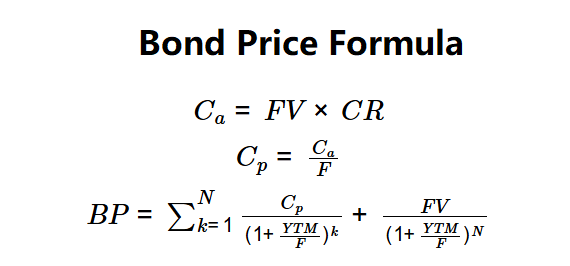
The price of the bond is therefore calculated by determining the present value of these future payments.
A simplified version of a formula is as follows:
Bond Price = Present Value of Coupon Payments + Present Value of Face Value
It sounds daunting.
But the basic principle of it reflects simply that money that you receive sometime in the future is worth less to you than an equivalent amount that you receive right now.