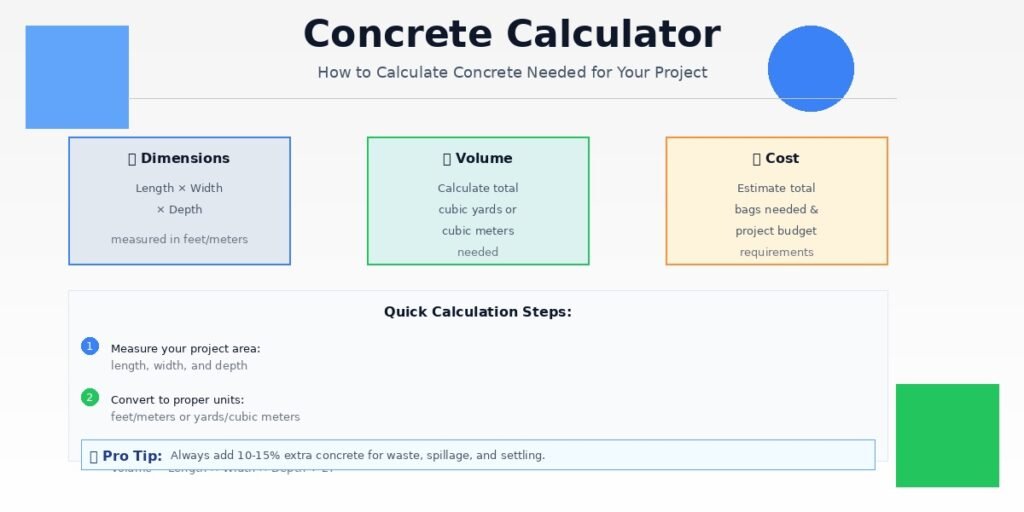
If you’re planning to pour a concrete slab, patio, driveway, footing, or another project, one of the first things you’ll need to figure out is how much concrete to order.
If you want to calculate the amount of concrete you need quickly, use our Concrete Calculator.
It sounds a little complicated at first, especially when concrete is sold by the cubic yard. But the basic calculation is actually pretty simple. You need the length, width, and depth of the area, and then you can work out the volume.
If you don’t want to do the math yourself, our Concrete Calculator can calculate the amount for you.
How Do You Calculate the Amount of Concrete?
For a rectangular area, the basic formula is:
Length × Width × Depth = Volume
The important part is making sure all three measurements use the same unit.
For example, let’s say you’re pouring a concrete slab that is 20 feet long, 10 feet wide, and 4 inches deep.
The length and width are in feet, so first convert the depth from inches to feet:
4 ÷ 12 = 0.333 feet
Now multiply:
20 × 10 × 0.333 = 66.6 cubic feet
So the slab needs about 66.6 cubic feet of concrete.
How Do You Convert Cubic Feet to Cubic Yards?
Concrete is often ordered in cubic yards rather than cubic feet.
Since one cubic yard contains 27 cubic feet, you can convert your result by dividing by 27.
Using the example above:
66.6 ÷ 27 = 2.47 cubic yards
So you would need approximately 2.47 cubic yards of concrete before adding any extra.
This conversion is important because ordering the wrong amount can become expensive, especially if you discover that you don’t have enough concrete after the pour has already started.
Concrete Calculator Example
Let’s try another example.
Suppose you’re making a patio that is 24 feet long, 12 feet wide, and 5 inches thick.
First, convert 5 inches to feet:
5 ÷ 12 = 0.417 feet
Then calculate the volume:
24 × 12 × 0.417 = 120.1 cubic feet
Now convert that to cubic yards:
120.1 ÷ 27 = 4.45 cubic yards
The calculation gives you about 4.45 cubic yards.
In a real project, you may want to order a little more than the exact calculated amount.
How Much Extra Concrete Should You Order?
Your measurements may be accurate, but the actual amount of concrete needed isn’t always exactly the same as the mathematical result.
The ground may not be perfectly level, the depth can vary slightly, and some concrete can be left behind during the pour.
For that reason, many people allow an extra 5% to 10% depending on the project and how accurate the measurements are.
For example, if your calculation comes to 4.45 cubic yards and you add 10%:
4.45 × 1.10 = 4.90 cubic yards
You would then discuss the amount with your concrete supplier and find out what quantity makes sense to order.
Calculating Concrete for Footings
The same basic idea works for rectangular footings.
Suppose a footing is 30 feet long, 2 feet wide, and 1 foot deep:
30 × 2 × 1 = 60 cubic feet
Convert that to cubic yards:
60 ÷ 27 = 2.22 cubic yards
If a project has several separate footings, calculate each one and add the results together.
For more complicated foundations, it’s worth checking the measurements and specifications with a qualified professional before ordering concrete.
What If the Area Is Not Rectangular?
Some projects aren’t simple rectangles.
If you have an L-shaped patio, for example, you can divide it into two rectangular sections. Calculate the concrete needed for each section and then add the two results.
Circular areas require a different calculation because you need the radius and depth.
The main idea stays the same: find the volume of the space you’re filling and then convert it to the unit used by your concrete supplier.
Common Concrete Calculation Mistakes
One of the easiest mistakes to make is forgetting to convert inches to feet.
If your slab is 4 inches thick, you can’t simply use 4 as the depth while using feet for the length and width. You need to convert it first:
4 inches = 0.333 feet
Another common mistake is calculating only the surface area.
Length × width tells you the area, but concrete is a three-dimensional material. You also need the depth to find the volume.
It’s also a good idea to double-check your measurements before placing an order.
Use Our Concrete Calculator
Doing the calculation by hand is useful when you want to understand how it works, but an online calculator is much quicker when you’re comparing different sizes.
Enter the length, width, and depth of your project into our Concrete Calculator to estimate the amount of concrete you’ll need.
For a large or structural project, use the calculator as an estimate and confirm the final quantity with your contractor or concrete supplier.
Frequently Asked Questions
How much concrete do I need for a 10 × 10 slab?
The amount depends on the thickness. For example, a 10 × 10 foot slab that is 4 inches thick needs about 1.23 cubic yards of concrete before allowing for extra.
How many cubic feet are in a cubic yard?
There are 27 cubic feet in one cubic yard.
Should I order more concrete than the calculator shows?
Usually, it’s sensible to allow for some extra material because actual conditions may differ from your measurements.
What measurements do I need for a concrete calculator?
For a basic rectangular project, you need the length, width, and depth.
Can I calculate concrete for a driveway?
Yes. Measure the driveway’s length, width, and average thickness, then use those measurements to calculate the volume. If the driveway has different sections or thicknesses, calculate each section separately.