If you want to calculate your BMI, you only need two things: your weight and your height. The calculation itself is pretty simple, and you can do it with a calculator in a few seconds.
BMI stands for Body Mass Index. It is a number based on your height and weight that is commonly used to put adults into general weight categories.
You can use our BMI Calculator to get the result automatically, or you can calculate it yourself using the formula below.
What Is the BMI Formula?
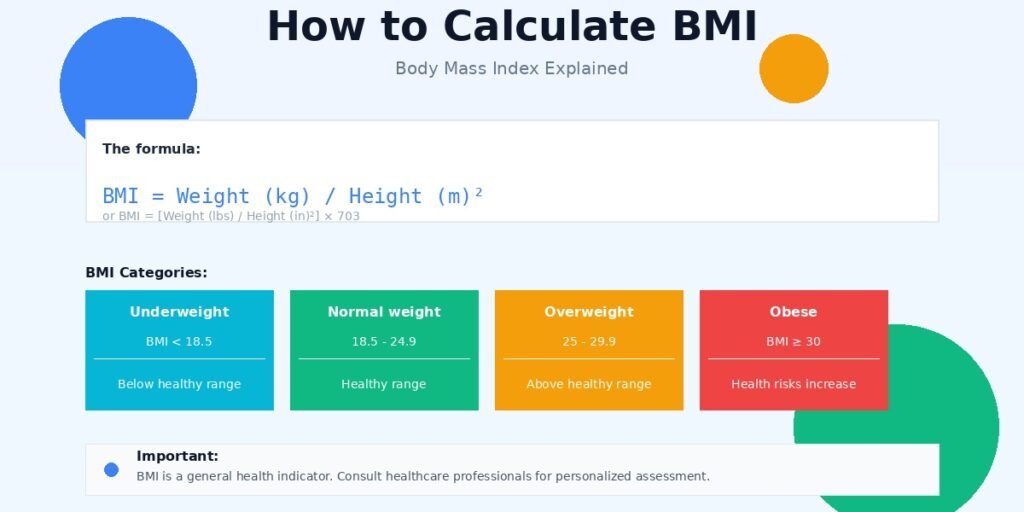
The standard BMI formula for adults is:
BMI = weight in kilograms ÷ (height in meters × height in meters)
For example, suppose you weigh 70 kg and your height is 1.75 meters.
First, multiply your height by itself:
1.75 × 1.75 = 3.0625
Then divide your weight by that number:
70 ÷ 3.0625 = 22.86
Your BMI would be approximately 22.9.
That’s all there is to the calculation.
How to Calculate BMI Using Pounds and Inches
If you normally measure your weight in pounds and your height in inches, you can use a different version of the formula:
BMI = (weight in pounds × 703) ÷ (height in inches × height in inches)
For example, imagine someone weighs 154 pounds and is 69 inches tall.
The calculation would be:
(154 × 703) ÷ (69 × 69) = 22.7
So the BMI is about 22.7.
If you don’t want to do the math yourself, enter your height and weight into a BMI calculator and it will do the calculation for you.
What Does Your BMI Number Mean?
For adults, BMI is generally grouped into four categories:
- Below 18.5: Underweight
- 18.5 to 24.9: Healthy weight
- 25.0 to 29.9: Overweight
- 30.0 or higher: Obesity
These ranges are useful as a general reference, but BMI is not a complete measurement of someone’s health.
For example, BMI does not directly measure body fat. A person who has a lot of muscle may have a higher BMI even though they have relatively little body fat.
That’s one reason it’s better to look at BMI as one piece of information rather than a complete health assessment.
Why Is BMI Used?
BMI is popular because it is quick and inexpensive to calculate. It can give a general idea of whether a person’s weight is low, within a commonly used range, or high relative to their height.
Doctors and health organizations may use BMI as part of a broader assessment. Other factors can also matter, including waist size, muscle mass, age, lifestyle, and overall health.
So if your BMI falls outside the commonly used range, it doesn’t automatically mean that something is wrong.
Is BMI Calculated the Same Way for Everyone?
The basic adult BMI formula is the same, but the result may need to be interpreted differently depending on the person.
For example, BMI categories for children and teenagers are not interpreted in exactly the same way as adult BMI. Their age and sex are taken into account when assessing BMI.
Pregnancy is another situation where the standard BMI calculation isn’t used to assess weight in the same way.
If you’re unsure how your BMI should be interpreted, it’s best to discuss it with a healthcare professional.
A Quick BMI Example
Let’s run through one more example.
Suppose a person weighs 80 kg and is 1.80 meters tall.
Start with the height:
1.80 × 1.80 = 3.24
Now divide the weight by the result:
80 ÷ 3.24 = 24.69
The BMI is approximately 24.7.
According to the commonly used adult categories, that falls within the 18.5–24.9 range.
Use a BMI Calculator
Doing the calculation manually is easy once you know the formula, but a calculator is faster if you’re checking different weights or heights.
Enter your weight and height into our BMI Calculator, and you’ll get the BMI result without having to work through the formula yourself.
Keep in mind that BMI is only a general screening measure. It shouldn’t be used on its own to diagnose a health condition or determine whether someone is healthy.
Frequently Asked Questions
What is a normal BMI?
For adults, a BMI from 18.5 to 24.9 is commonly classified as the healthy-weight range. This is a general guideline, not a diagnosis.
Can I calculate BMI at home?
Yes. You only need your weight and height. You can use the BMI formula or an online calculator.
Is BMI the same for men and women?
The standard adult BMI formula is the same for men and women. However, BMI doesn’t account for differences in body composition, so the number doesn’t tell the whole story.
Is BMI accurate?
BMI can be useful as a general screening tool, but it doesn’t directly measure body fat or distinguish between muscle and fat. It should therefore be interpreted in context.
If you want to check your BMI quickly, use our BMI Calculator to get your result in seconds