How to Calculate a Percentage
Percentages show up everywhere — your grocery receipt, a job offer salary breakdown, a school report card. If you’ve ever stared at a number and thought, “wait, how do I actually work this out?”, you’re in the right place.
Calculate a Percentage
This guide is for anyone who wants a straightforward way to calculate a percentage without dusting off a math textbook. Students, small business owners, and everyday people crunching numbers on their lunch break will all find something useful here.
Here’s what we’ll walk through:
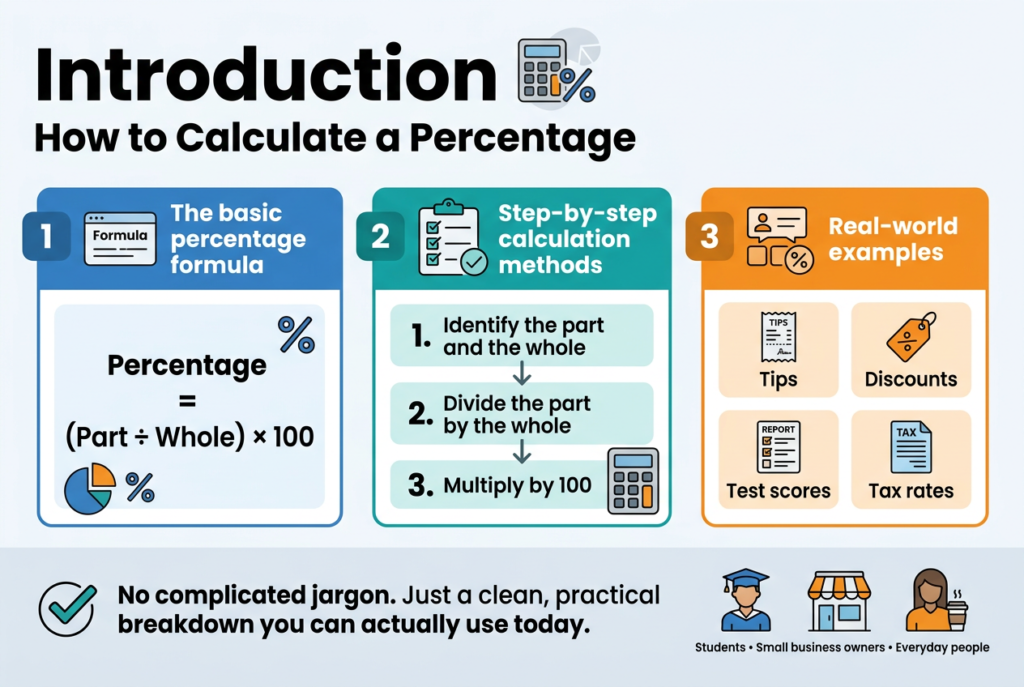
- The basic percentage formula — one simple equation that handles most situations
- Step-by-step calculation methods — so you can work through any percentage problem with confidence
- Real-world examples — from tips and discounts to test scores and tax rates
No complicated jargon, no long detours. Just a clean, practical breakdown you can actually use today.
Understanding the Basics of Percentages
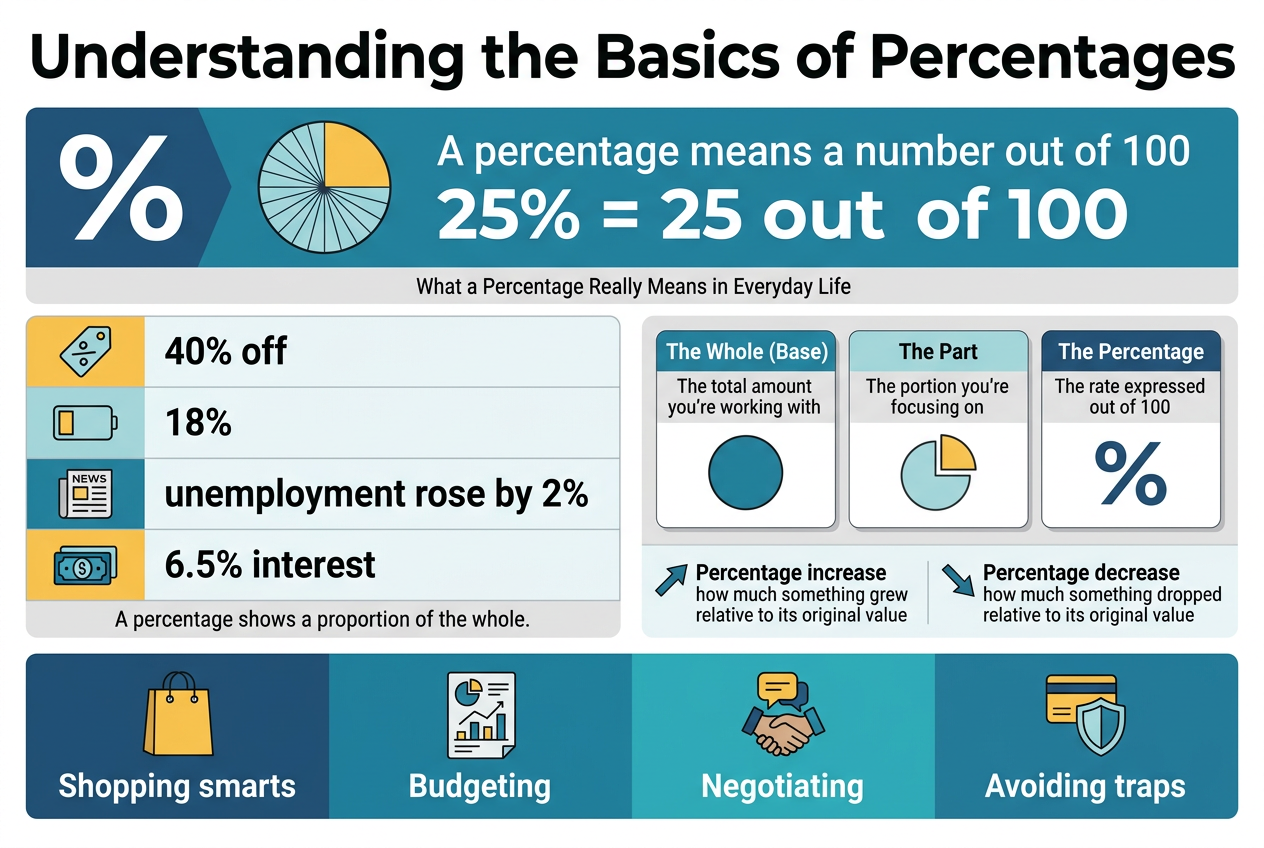
What a Percentage Really Means in Everyday Life
A percentage is simply a way of expressing a number as a fraction of 100. The word itself comes from the Latin per centum, meaning “out of a hundred.” So when you see 25%, you’re really just looking at 25 out of every 100 parts of something.
You run into percentages constantly without even thinking about it:
- A store sign reads “40% off”
- Your phone battery hits 18%
- A news headline says “unemployment rose by 2%”
- Your bank charges 6.5% interest on a loan
In each case, the percentage tells you a proportion — how big or small a piece is relative to the whole.
Key Terms You Need to Know Before You Start
Before diving into calculations, get comfortable with three core terms:
| Term | What It Means | Example |
|---|---|---|
| The Whole (Base) | The total amount you’re working with | A $200 jacket |
| The Part | The portion you’re focusing on | $50 discount |
| The Percentage | The rate expressed out of 100 | 25% |
Two other terms worth knowing:
- Percentage increase – how much something grew relative to its original value
- Percentage decrease – how much something dropped relative to its original value
Once you can identify these pieces in any problem, the actual math becomes much easier to handle.
Why Mastering Percentages Saves You Time and Money
People who understand percentages make better decisions — plain and simple. Here’s where that shows up in real life:
- Shopping smarts: You can quickly judge whether a “sale” is actually worth it or just clever marketing.
- Budgeting: Knowing that you’re spending 35% of your income on rent helps you see the full picture fast.
- Negotiating: Whether it’s a salary bump or a car price, talking in percentages gives you a common language with the other person.
- Avoiding traps: Credit card companies love hiding costs in percentage terms. Understanding APR can save you hundreds of dollars a year.
The good news? You don’t need to be a math person to get good at this. A few solid techniques and a bit of practice go a long way.
The Simple Formula Behind Every Percentage Calculation
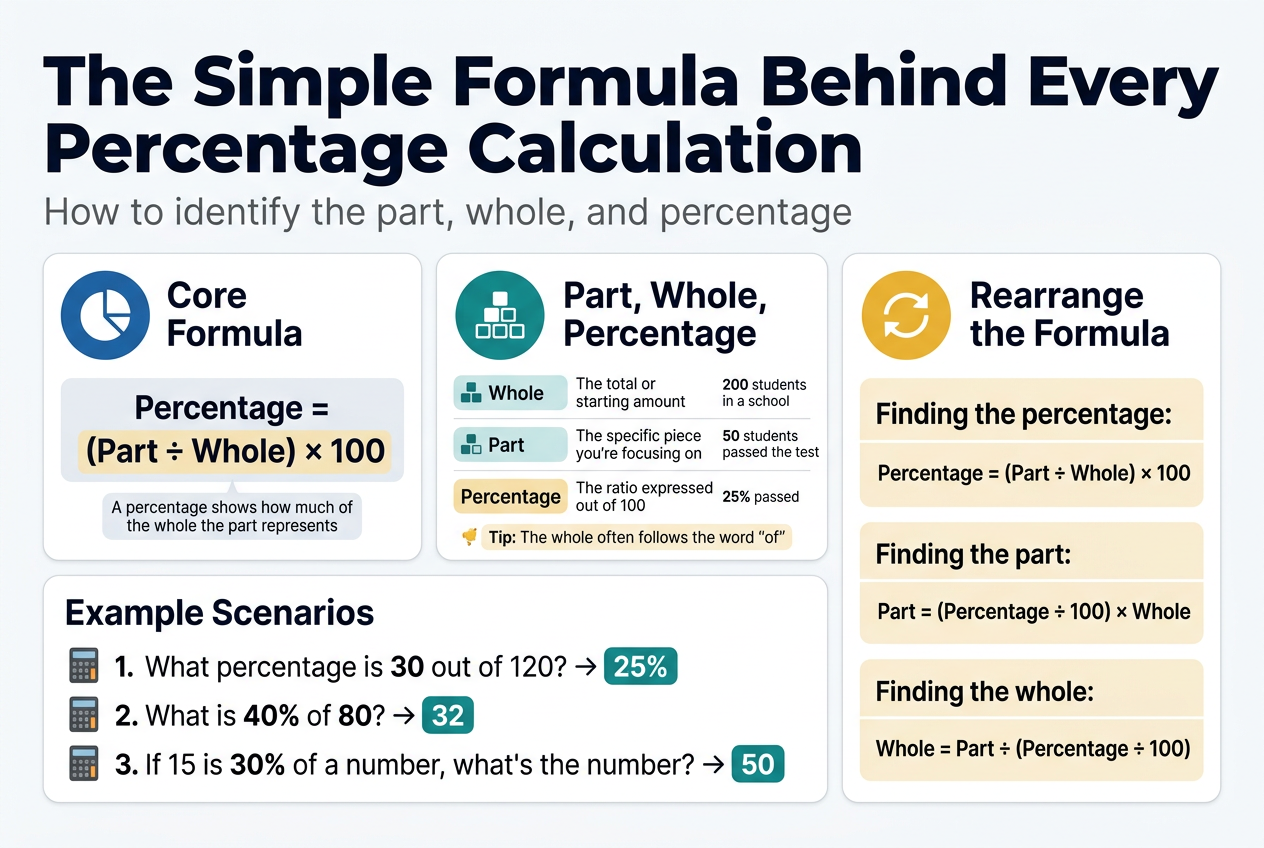
Breaking Down the Core Percentage Formula
Every percentage calculation comes down to one simple relationship:
Percentage = (Part ÷ Whole) × 100
That’s it. Whether you’re figuring out a tip at dinner or analyzing sales data at work, this formula handles everything. The result tells you how much of the whole the part represents, expressed as a number out of 100.
Identifying the Part, Whole, and Percentage in Any Problem
Before plugging numbers in, you need to spot which value is which.
| Term | What It Means | Example |
|---|---|---|
| Whole | The total or starting amount | 200 students in a school |
| Part | The specific piece you’re focusing on | 50 students passed the test |
| Percentage | The ratio expressed out of 100 | 25% passed |
A quick trick: the whole usually follows the word “of,” and the part is what you’re measuring or comparing.
How to Rearrange the Formula to Solve Different Problems
The base formula has three variables, so you can rearrange it depending on what you’re missing:
- Finding the percentage:
Percentage = (Part ÷ Whole) × 100 - Finding the part:
Part = (Percentage ÷ 100) × Whole - Finding the whole:
Whole = Part ÷ (Percentage ÷ 100)
Example scenarios:
- What percentage is 30 out of 120? → (30 ÷ 120) × 100 = 25%
- What is 40% of 80? → (40 ÷ 100) × 80 = 32
- If 15 is 30% of a number, what’s the number? → 15 ÷ 0.30 = 50
Quick Tips for Avoiding Common Formula Mistakes
A few small slip-ups cause most percentage errors:
- Mixing up part and whole — always double-check which number represents the total
- Forgetting to multiply by 100 — dividing alone gives you a decimal, not a percentage
- Moving the decimal incorrectly — converting 40% to a decimal means dividing by 100, giving you 0.40, not 4.0
- Confusing percentage change with percentage of — these are different calculations entirely
When in doubt, write the formula out before solving. Rushing the setup is where most mistakes happen, not the math itself.
Step-by-Step Methods for Calculating Percentages
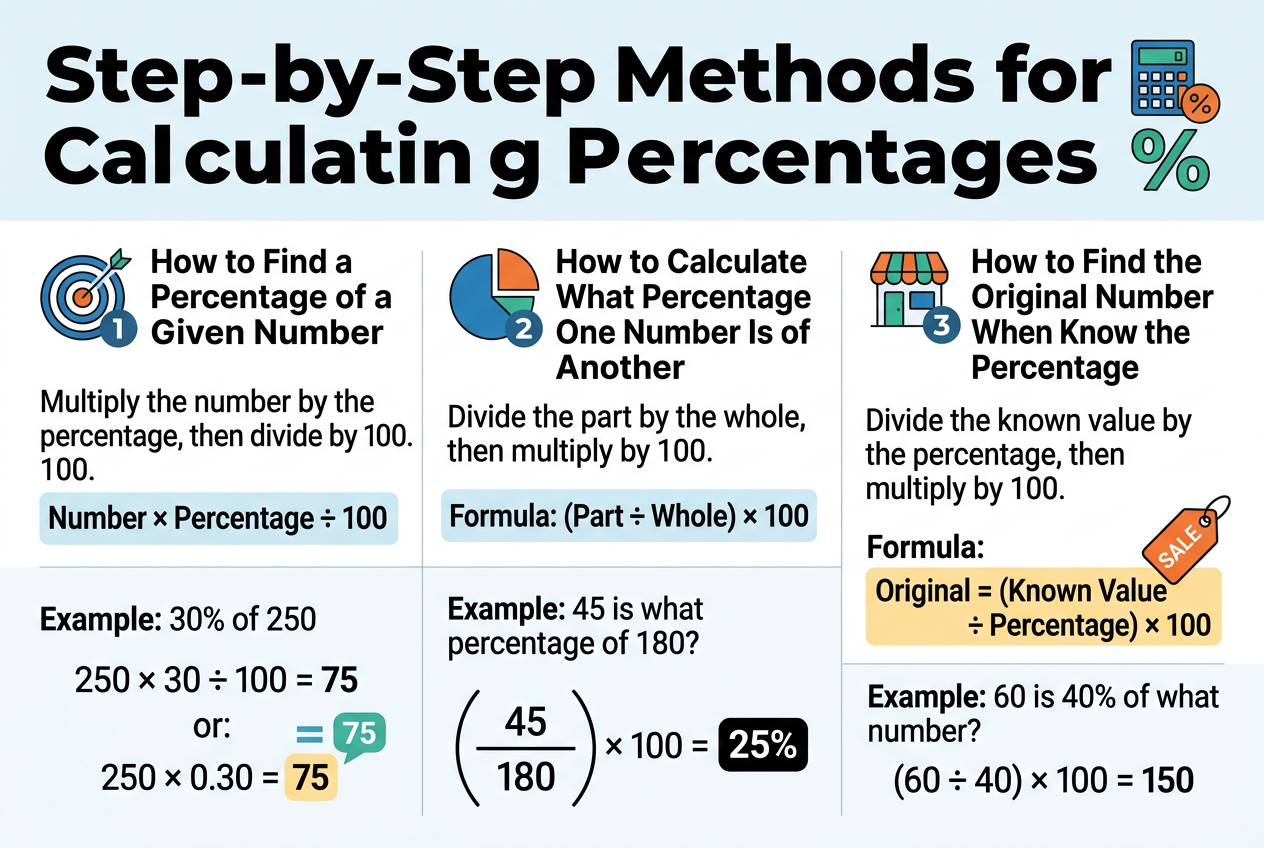
How to Find a Percentage of a Given Number
Multiply the number by the percentage, then divide by 100.
Example: What is 30% of 250?
- 250 × 30 ÷ 100 = 75
Or convert the percentage to a decimal first: 250 × 0.30 = 75. Both paths get you to the same answer.
How to Calculate What Percentage One Number Is of Another
Divide the part by the whole, then multiply by 100.
Formula: (Part ÷ Whole) × 100
Example: 45 is what percentage of 180?
- (45 ÷ 180) × 100 = 25%
How to Find the Original Number When You Know the Percentage
Divide the known value by the percentage, then multiply by 100.
Formula: Original = (Known Value ÷ Percentage) × 100
Example: 60 is 40% of what number?
- (60 ÷ 40) × 100 = 150
This works great when you know a sale price and want to find the original retail price.
How to Calculate Percentage Change Between Two Values
This tells you how much something grew or dropped relative to its starting point.
Formula: ((New Value − Old Value) ÷ Old Value) × 100
| Situation | Old Value | New Value | Calculation | Result |
|---|---|---|---|---|
| Price increase | $80 | $100 | (20 ÷ 80) × 100 | 25% increase |
| Price drop | $200 | $150 | (−50 ÷ 200) × 100 | 25% decrease |
A positive result means growth; a negative result means a decline.
Using Cross-Multiplication as an Alternative Approach
Cross-multiplication is a solid backup when the numbers feel awkward to work with directly.
Set up the problem as a proportion:
Part / Whole = Percentage / 100
Example: What is 15% of 340?
- x / 340 = 15 / 100
- x = (340 × 15) ÷ 100 = 51
This method is especially handy for students or anyone who finds fractions easier to visualize than decimals. It’s the same math, just framed differently — pick whichever version clicks for you.
Practical Tools to Speed Up Your Calculations
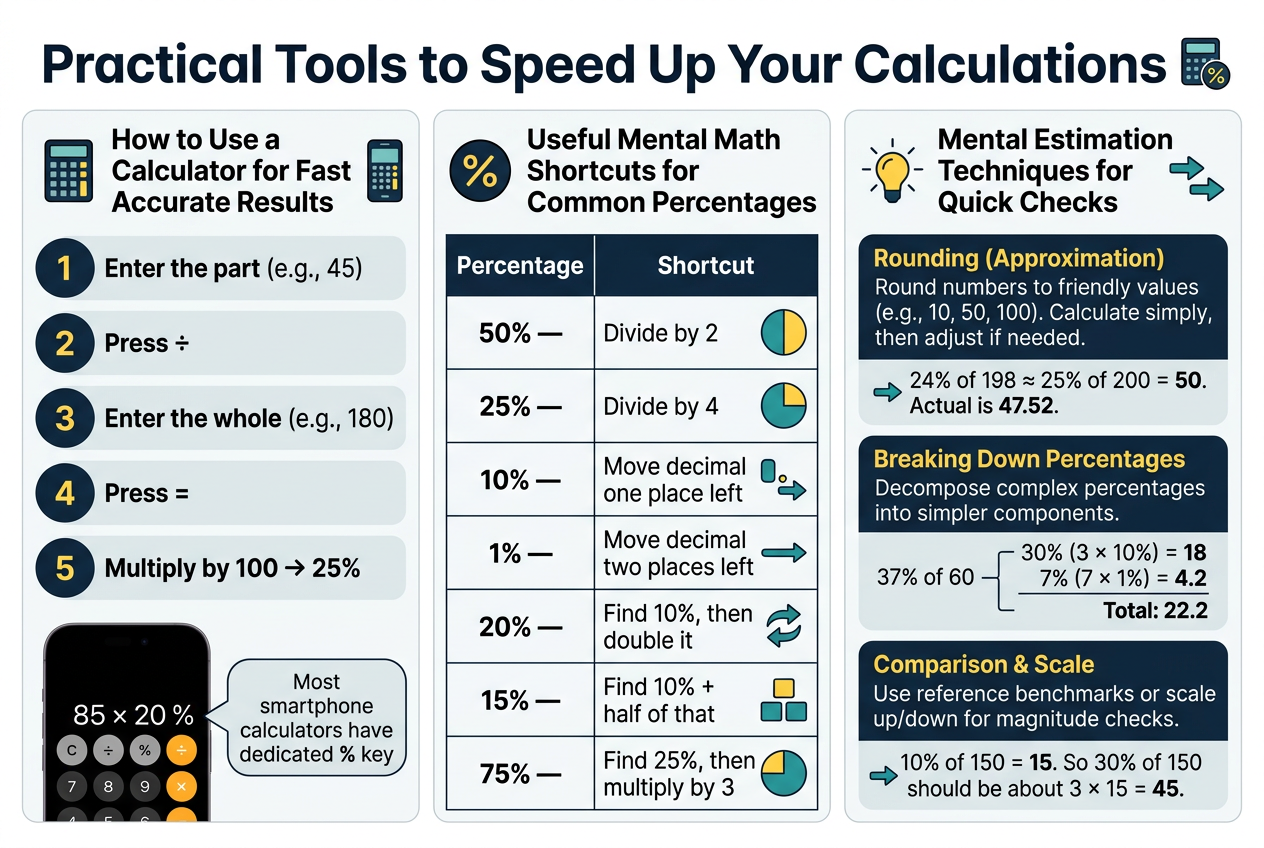
How to Use a Calculator for Fast and Accurate Results
Your calculator — whether physical or on your phone — handles percentages in seconds once you know the right buttons to press.
Basic percentage on a calculator:
- Enter the part (e.g., 45)
- Press ÷
- Enter the whole (e.g., 180)
- Press =
- Multiply by 100 → 25%
Most smartphone calculators also have a dedicated % key. To find 20% of $85, just type: 85 × 20 % — no extra steps needed.
Useful Mental Math Shortcuts for Common Percentages
A few tricks let you skip the calculator entirely for the most common percentages:
| Percentage | Shortcut |
|---|---|
| 50% | Divide by 2 |
| 25% | Divide by 4 |
| 10% | Move decimal one place left |
| 1% | Move decimal two places left |
| 20% | Find 10%, then double it |
| 15% | Find 10% + half of that |
| 75% | Find 25%, then multiply by 3 |
Example: What’s 15% of $60?
- 10% of $60 = $6
- Half of $6 = $3
- $6 + $3 = $9
Combine these building blocks and you can handle tips, discounts, and quick estimates in your head before the cashier even finishes typing.
Helpful Online Percentage Calculators Worth Bookmarking
When you need precise answers fast — especially for finance or school — these tools do the heavy lifting:
- Calculator.net/percent-calculator — Covers all common percentage problem types with clear explanations of each result.
- RapidTables Percentage Calculator — Clean, minimal interface with three different calculation modes.
- Omni Calculator – Percentage — Great for multi-step problems and includes a percentage change calculator.
- Google Search Bar — Type something like
"what is 35% of 240"directly into Google and get an instant answer with a built-in calculator popup.
Each tool suits a slightly different situation, so keeping a couple bookmarked saves real time when you’re in the middle of budgeting, grading, or comparing sale prices.
Real-World Applications That Make Percentages Useful
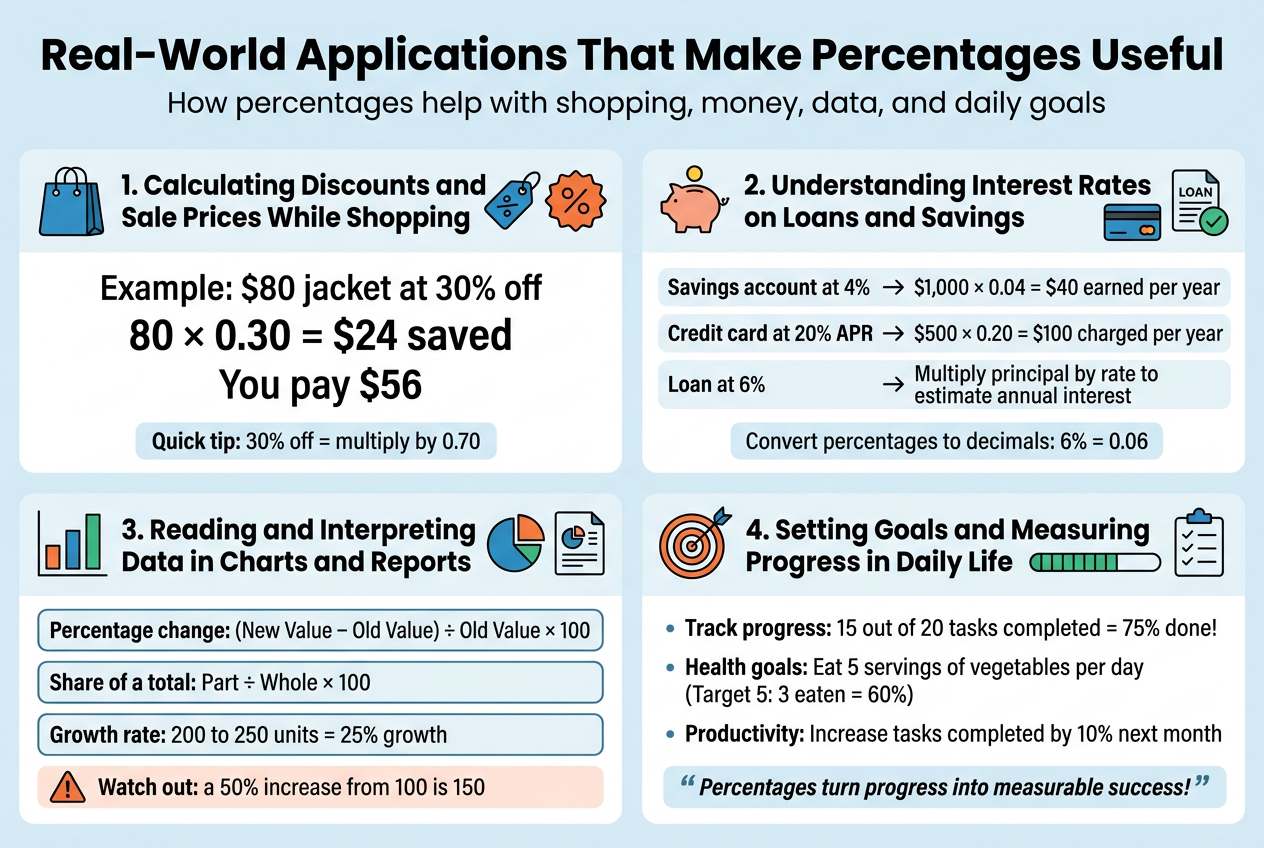
Calculating Discounts and Sale Prices While Shopping
Spotting a “30% off” sign is exciting — but knowing exactly how much you’ll save makes it even better. Multiply the original price by the discount percentage (as a decimal), and you have your savings.
Example: A $80 jacket at 30% off → 80 × 0.30 = $24 saved → You pay $56
Quick tip: To find the final price directly, subtract the percentage from 100 and multiply. For 30% off, multiply by 0.70. One step, done.
Understanding Interest Rates on Loans and Savings
Interest rates are percentages working either for you (savings) or against you (debt). Knowing how to read them saves real money.
| Situation | How It Works |
|---|---|
| Savings account at 4% | $1,000 × 0.04 = $40 earned per year |
| Credit card at 20% APR | $500 balance × 0.20 = $100 charged per year |
| Loan at 6% | Multiply principal by rate to estimate annual interest |
The key habit: always convert the percentage to a decimal before calculating. Move the decimal two places left — 6% becomes 0.06.
Reading and Interpreting Data in Charts and Reports
Charts and reports throw percentages at you constantly — market share, survey results, growth rates. Knowing what they actually mean helps you think critically instead of just nodding along.
- Percentage change: (New Value − Old Value) ÷ Old Value × 100
- Share of a total: Part ÷ Whole × 100
- Growth rate: If sales jumped from 200 to 250 units → (250−200) ÷ 200 × 100 = 25% growth
Watch out for misleading framing. A “50% increase” sounds massive, but if it went from 2 to 3, context matters everything.
Applying Percentages to Cooking, Fitness, and Daily Goals
Percentages quietly run your daily life too.
- Cooking: Baker’s percentages express ingredient ratios relative to flour weight, making it easy to scale recipes up or down.
- Fitness: Tracking that you completed 80% of your weekly workout plan helps you stay honest without being harsh.
- Daily goals: If your water goal is 2,500ml and you drank 1,750ml, you hit 70% — still something to build on.
Breaking goals into percentages turns vague progress into something you can actually measure and adjust.
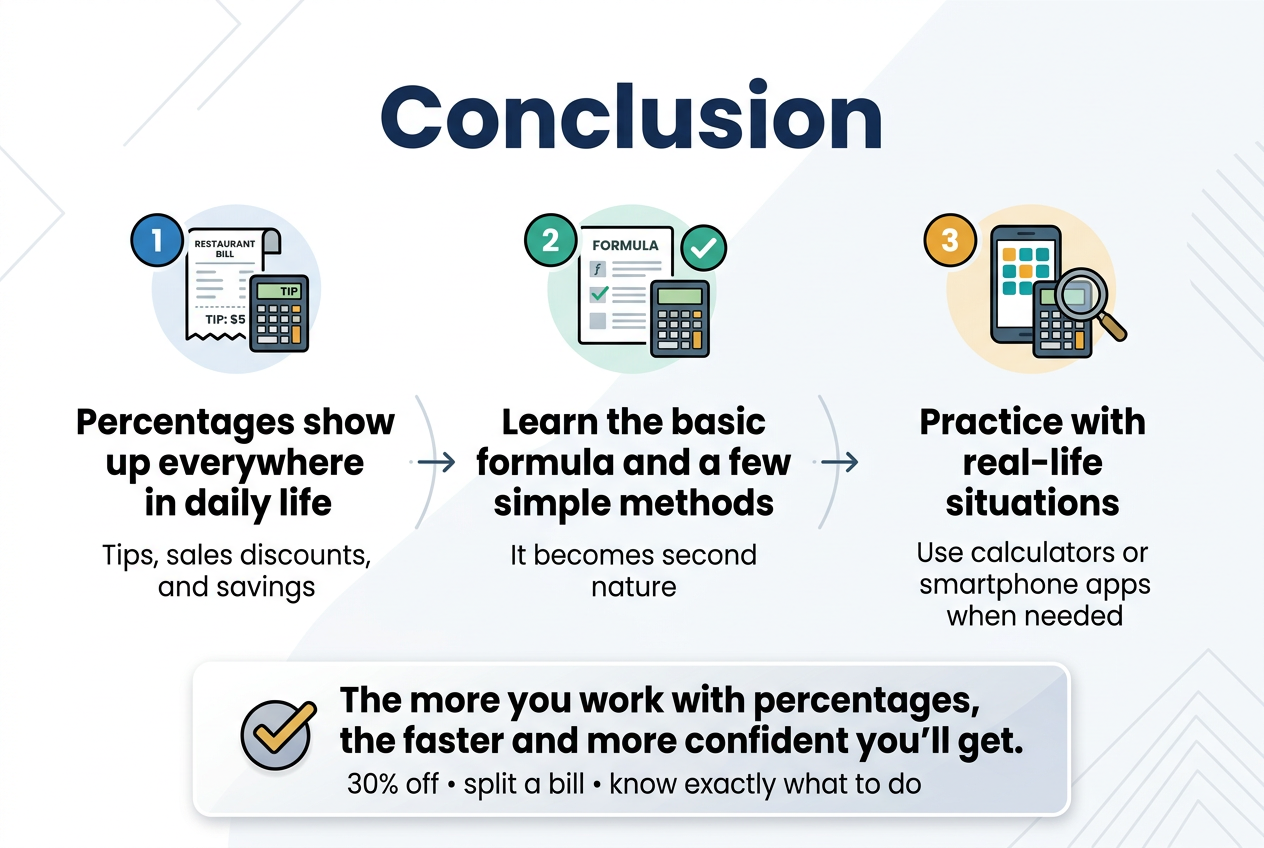
Percentages show up everywhere in daily life — from figuring out a tip at a restaurant to understanding a sale discount or tracking your savings. Once you get comfortable with the basic formula and a few simple methods, the whole process becomes second nature. The good news is that you don’t need to be a math whiz to get it right every time.
Start practicing with real-life situations around you, and don’t hesitate to lean on tools like calculators or smartphone apps when you need a quick answer. The more you work with percentages, the faster and more confident you’ll get. So next time you spot a “30% off” sign or need to split a bill, you’ll know exactly what to do.